 Image 1 of 1
€ Enquire
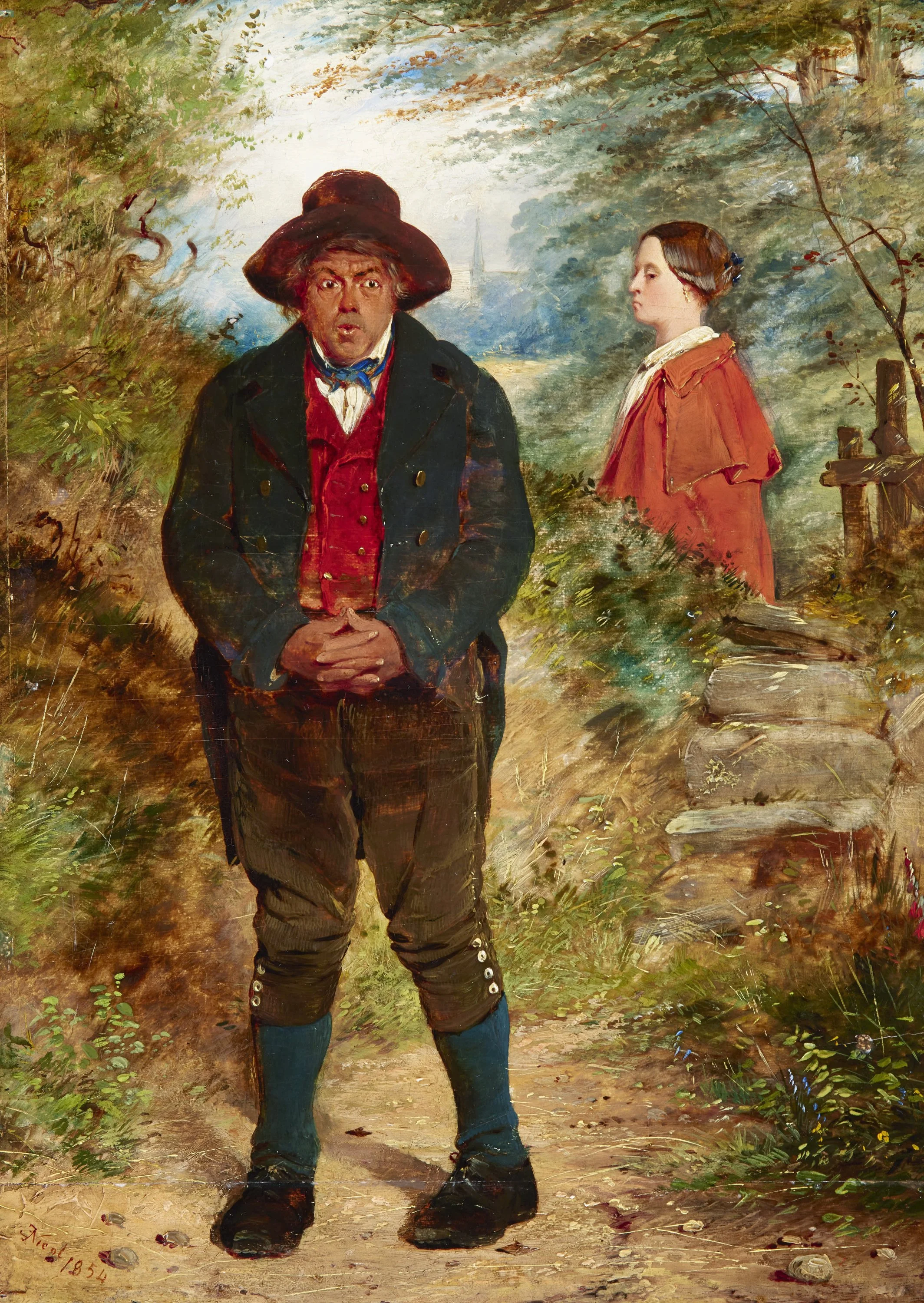
The Rejected
Oil on Wood, 33.7 x 24.4cm
Signed and dated 1854
This painting forms the basis for the lithograph drawn in stone by John Sutcliffe, printed by Waterlow & Sons, published by James Keith, London and New York
This disappointed suitor with his hands crossed in affliction embodies Nicol’s visual comedy. He has just been ‘rejected’ by his sweetheart, placed behind him with a tense expression. Both characters are complete opposites: he is all hunched over, while she is straight and stiff, he is painted in dark green and red, while her clothes are coloured in bright white and vivid red. He has been petrified by her refusal, but she is moving along. Moreover, the vegetation between them literally takes them apart. So, the steps of stone which could allow him to move in her direction seem like an ironical staircase that this knight without shining armour will never climb to reach his princess. Furthermore, religion and its strict regulation of men and women’s relationships is hinted at, with the blue pike of a church visible in the centre, between them. It is so far away that this lover will never have a chance to lead his beloved there to marry her. Anyway, his embarrassed left leg suggests that he is not about to move any time soon. In the foreground, and indifferent to this lover’s misery, flowers are in full blossom, revealing the attention paid to nature. In the 1850s, artists were encouraged to do so by John Ruskin. Yet, the main interest of Nicol’s picture is its rejoicing nature, which explains why it was engraved. In fact, humorous lithographs were likely to be popular, especially when they formed a pair, as in The Rejected and The Accepted.
Dr. Amélie Dochy
€ Enquire
The Rejected
Oil on Wood, 33.7 x 24.4cm
Signed and dated 1854
This painting forms the basis for the lithograph drawn in stone by John Sutcliffe, printed by Waterlow & Sons, published by James Keith, London and New York
This disappointed suitor with his hands crossed in affliction embodies Nicol’s visual comedy. He has just been ‘rejected’ by his sweetheart, placed behind him with a tense expression. Both characters are complete opposites: he is all hunched over, while she is straight and stiff, he is painted in dark green and red, while her clothes are coloured in bright white and vivid red. He has been petrified by her refusal, but she is moving along. Moreover, the vegetation between them literally takes them apart. So, the steps of stone which could allow him to move in her direction seem like an ironical staircase that this knight without shining armour will never climb to reach his princess. Furthermore, religion and its strict regulation of men and women’s relationships is hinted at, with the blue pike of a church visible in the centre, between them. It is so far away that this lover will never have a chance to lead his beloved there to marry her. Anyway, his embarrassed left leg suggests that he is not about to move any time soon. In the foreground, and indifferent to this lover’s misery, flowers are in full blossom, revealing the attention paid to nature. In the 1850s, artists were encouraged to do so by John Ruskin. Yet, the main interest of Nicol’s picture is its rejoicing nature, which explains why it was engraved. In fact, humorous lithographs were likely to be popular, especially when they formed a pair, as in The Rejected and The Accepted.
Dr. Amélie Dochy