 Image 1 of 1
16. Erskine Nicol R.S.A., A.R.A. 1825-1904
€ Enquire
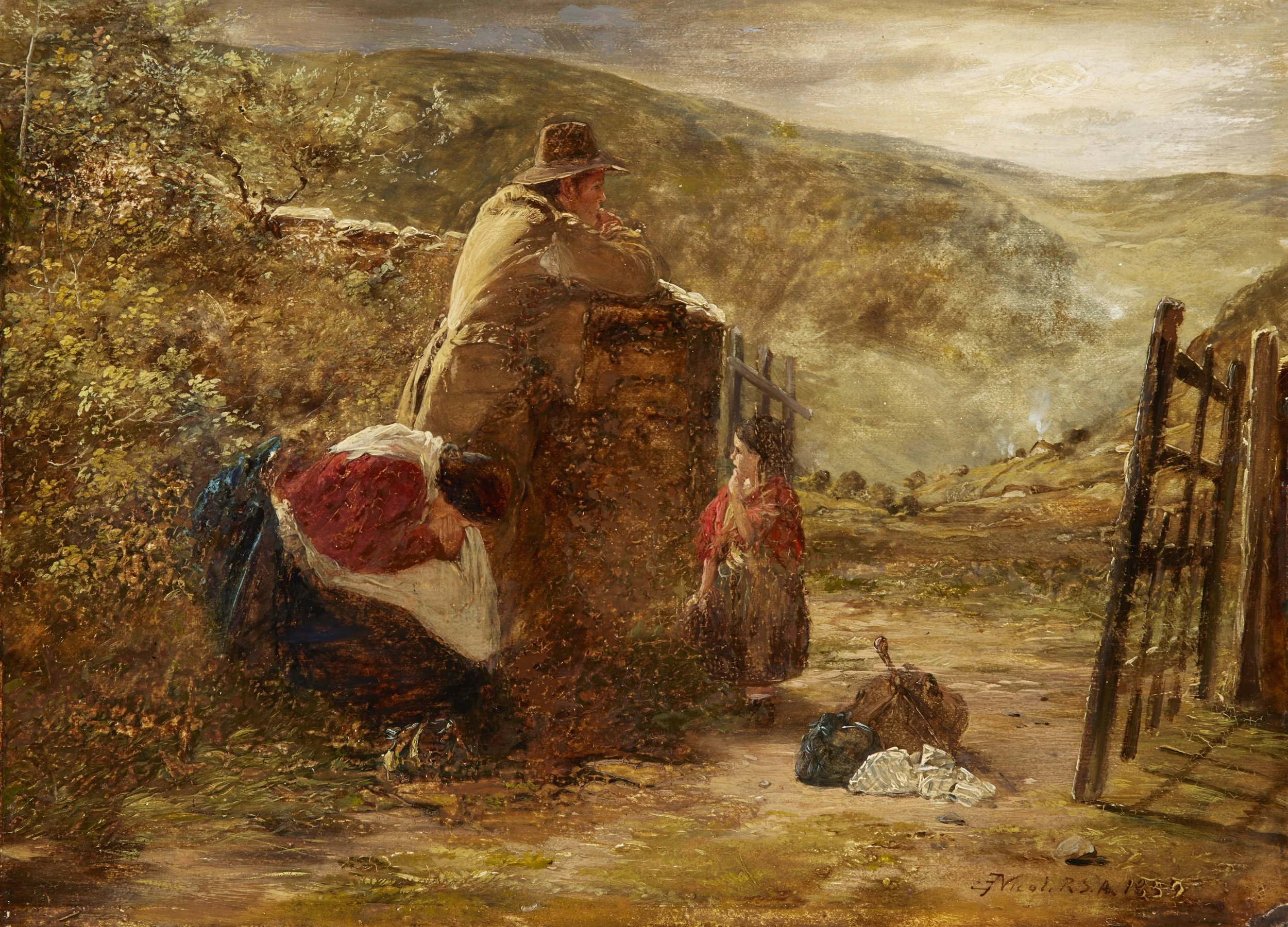
After the Eviction
Oil on Board, 25.5 x 35.5
Signed and dated 1850
After the Eviction is a historical record of the Great Famine (1845-1852). Because of potato blight, destroying crops from 1845 onwards, many peasants could not pay their rent anymore, and were eventually evicted. Between 1849 and 1856, about "340,000 individuals'' were ejected from their cabin, and were thus deprived of their home and means of production. They had nowhere to go, as is well conveyed by this family, placed along a path. In the foreground, the mother is crying, portraying hopelessness. The gate suggests that they are pausing outside of the estate owned by their landlord. This gate may remind us of a prison, because of its vertical lines, meaning that the characters are trapped in dreadful economic circumstances. Their three little packs symbolise the family's few belongings. Their limited resources won't allow them to emigrate, unlike the two million Irish people who left in the 1850s. The stone wall symbolises exclusion from these emblematic cottages. In the eyes of the father, they must look like a lost paradise. Thus, the subject is redolent of the religious motif of Adam and Eve excluded from the Garden of Eden. Besides, this picture responds to images of the Holy Family during the flight into Egypt. Indeed, the light falling on the face of the child expresses her inno-cence, while her anxious gesture highlights the sacrifice of a whole generation. In the Victorian era, such political paintings were scarce, because they could be harshly rejected. As a result, Nicol's artwork is an exceptional example of early social realism. D. Macdonald addressed the Famine too in his Discovery of Potato Blight (1847) or his Eviction Scene (c. 1850). In all these paintings, the pastoral dimension - illustrated by Nicol in various hues of green, ochre, and yellow -, tend to romanticise the subject, just like the decision to represent the moment "before' or 'after' the eviction. Of course, evictions were violent, as expressed by H. J. Thaddeus's Eviction (RHA, 1890), but this was forty years after Nicol's picture, and at the end of the second land war. Nicol preferred a more pathetic vein, to which he would return in 1853 with his Ejected Family (NGI). Today, pictures like After the Eviction invite us to feel sympathy for the characters. And it is through such feelings that we may understand what the life of our ancestors might have been, what evictions meant in the Victorian era, and what homelessness still means nowadays. This is how Nicol's painting is an invitation to continue the moral struggle for the right to housing. Housing is a necessity for humans, as we all need a place to rest and to feel a sense of home, as is further explored in Waiting for the Praties.
Dr. Amélie Dochy
1. Perry L. Curtis, The Depiction of Eviction in Ireland, Dublin, UCDP, 2022, p. 28.
2. Valérie Morrison, ‘Visual Representations of the Great Famine, 1845-2010’, Revue Française de Civilisation Britannique, vol. 19, n°2, 2014, pp. 173-193, p. 181.
3. See Joel Mokyr, Why Ireland Starved, London, Allen, 1983.
4. Niamh Ann Kelly, ‘Remembering Homelessness in the Great Irish Famine’, in David A. Valone (ed.), Ireland’s Great Hunger, Lanham, UPA, 2010, pp. 140-60, p. 146