 Image 1 of 2
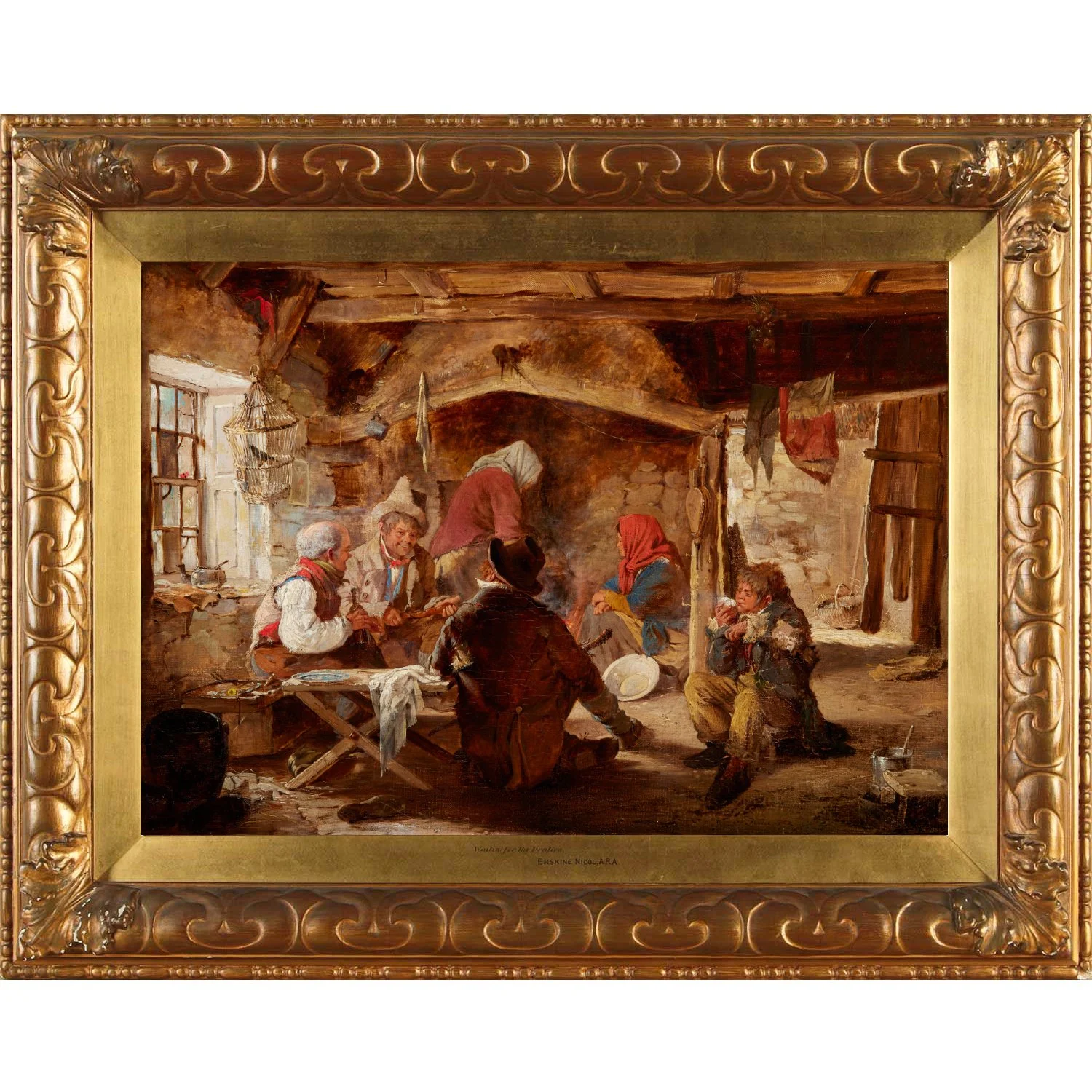 Image 2 of 2
€ Enquire
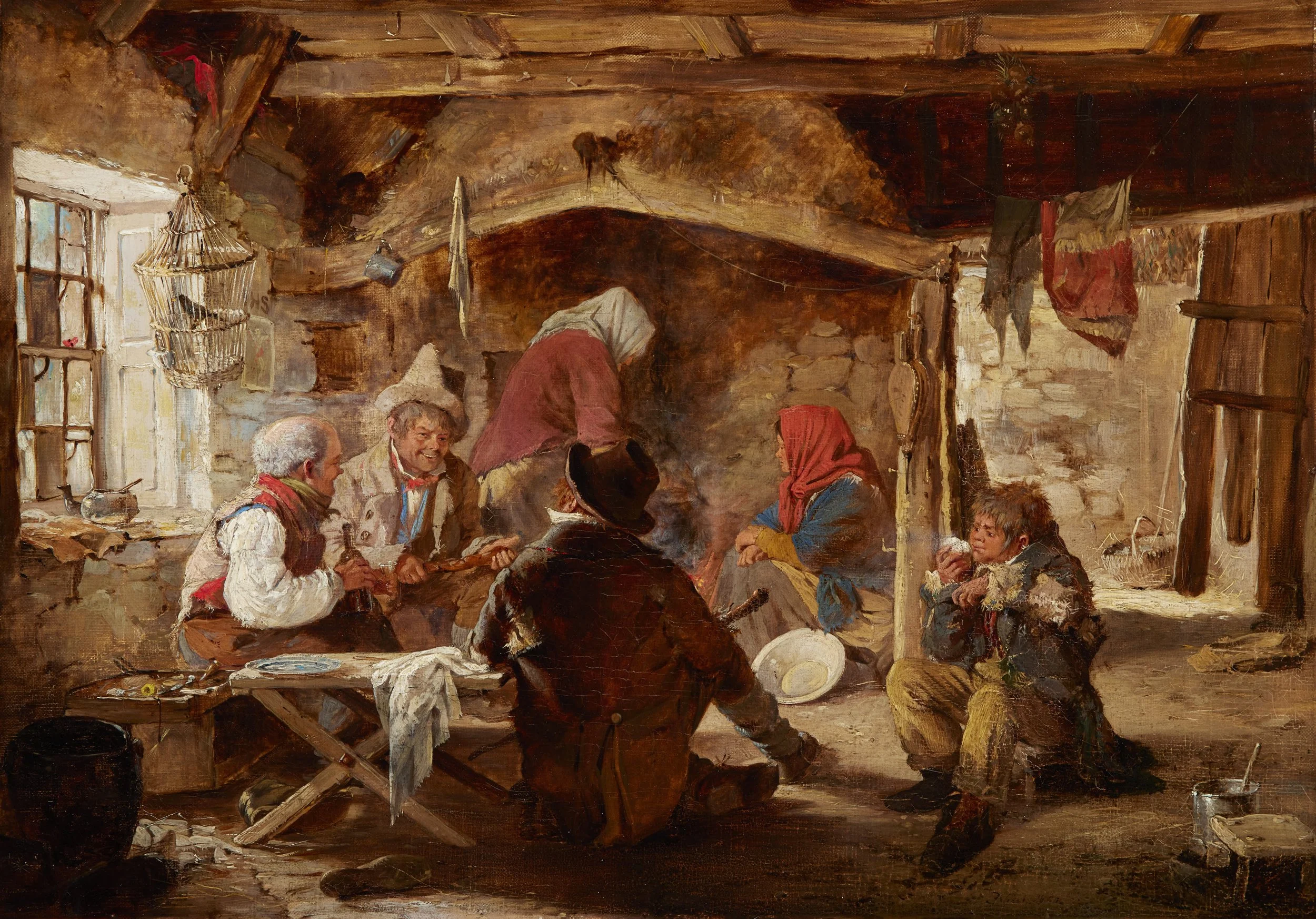
Waitin’ for the Praties
Oil on Canvas, 37.5 x 52.5cm
Signed and dated 1852
Also signed with title (original label verso)
Exhibited: Royal Scottish Academy, 1852, number 256
Provenance: William Rodman and Co, Belfast (original label verso)
This family illustrates the rhythm of daily life, with its moments of rest for the men around their table while busy women are cooking at the fireside. The mother is bending over her caldron, in which may be boiling the ‘praties’ (said ‘praw-teez’, transcribing the gaelic word prátaí, meaning potatoes). She is observed by her daughter, who will imitate her once she is married. So, Nicol depicts the Victorian canon of the angel in the house here. By contrast, the men are less idealised, with features encouraging viewers to guess their occupation. The man with a brown apron may be a carpenter. His neighbour has a pointed hat indicating that he is a peasant. He is telling the story of a faction fight, given the ways in which he holds his shillelagh. A red-haired boy is listening to him, hoping to become a good faction-fighter too, and his own shillelagh points at his brother. The youngest boy is sitting on a stool, engulfed in ragged clothes, and eagerly blowing on his food. The setting - with the bright window, the chimney hiding another room, and the closed door - refers to the intricated compositions of 17th-century Dutch Masters. The squares drawn by the panels of the window are redolent of Vermeer’s latticed windows. This parody of a well- known Old Master gives a Dutch atmosphere to this Irish scene. A picture with the same title was exhibited at the Royal Scottish Academy (RSA) in 1852 (n°256), a date corresponding to the last year of the Famine. So, Nicol’s intention might have been to illustrate hope after this scourge - even though rare were the peasants who were thriving by 1852. That year, Nicol also exhibited seven other artworks at the RSA5, which were mainly ‘humorous’, as noted in The Scotsman on 14 Feb. 1852 (p. 2). The newspaper also appreciated the ‘genuine Irish fun’ of Nicol in Waiting for the Praties (21 Feb. 1852, p. 3), which was regarded as ‘full of character’, especially with ‘the merry self-complacent man with the whisky-bottle, and the tattered creature blowing his hot potato’, qualified as ‘excellent’ (ibid.). Excellence is also found in the drawing of the willow plates, tea pot, black bird, or image of the Crucifixion, topped with the inscription ‘I.H.S’. Such images would inspire Van Gogh himself, who mentioned his admiration for Nicol in a letter to his brother, and who would also paint a similar peasant interior in his Potato Eaters (1885).
Dr. Amélie Dochy
5. If them wild Ducks would wait till I’m riddy (28), A Shubeen at Donnybrook (74), The Purshoot of Knowledge under Difficulthies (134), Cushla Machree, I am partin’ from thee (135), A Sketch in Leith (235), Satisfaction (599) and The Halt (610).