 Image 1 of 1
€ Enquire
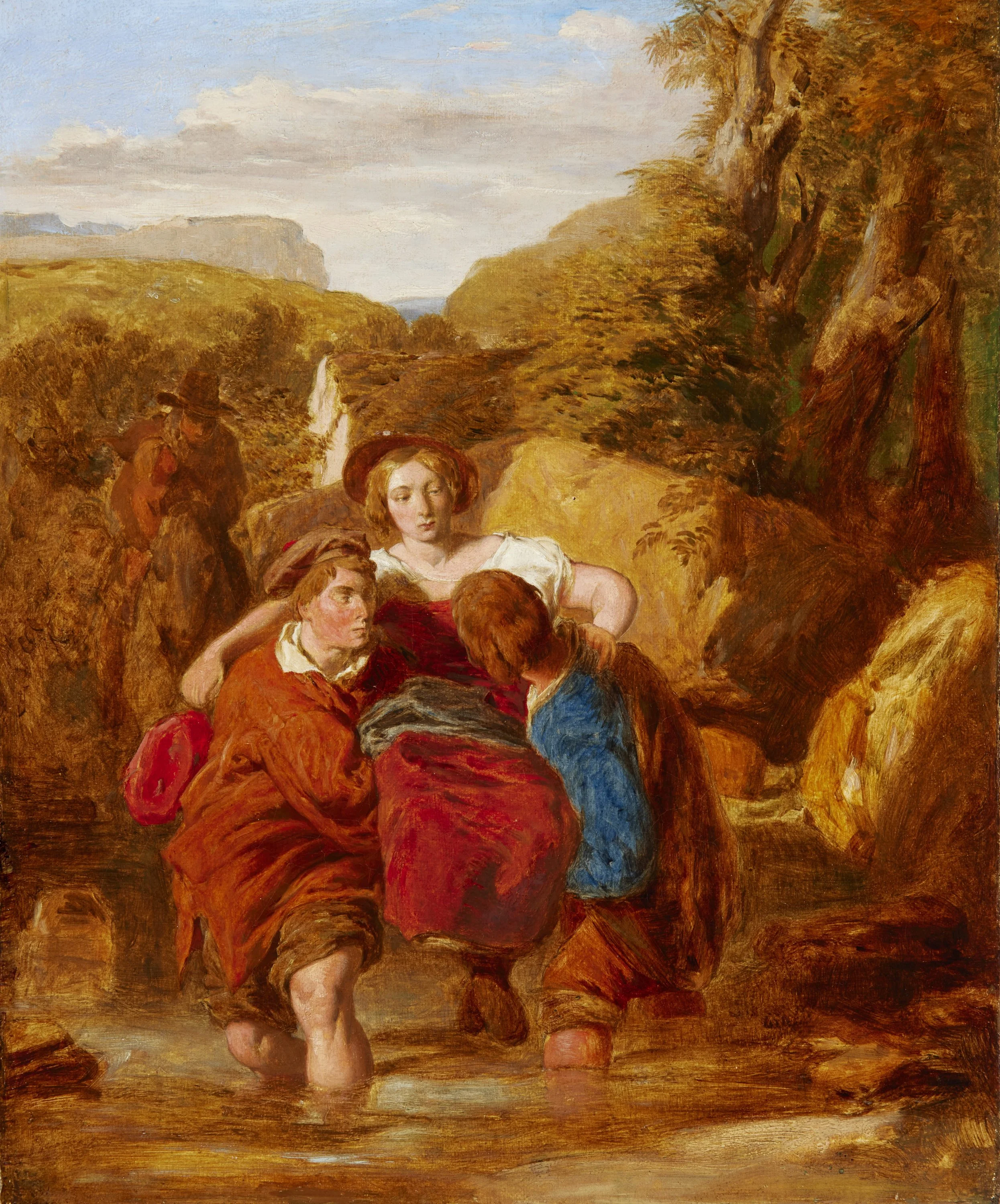
Crossing the Ford
Oil on Canvas, 30.5 x 25.5cm
Provenance: Sotheby’s London 13th November 1991, Lot 77
A smaller version of the painting by William Mulready exhibited at the Royal Academy in 1842 and now housed in Tate Britain, Crossing the Ford, is at first glance an unremarkable event of life in rural England. The subject of a ford crossing demonstrates the artist’s skill at creating original genre scenes which contain hidden meanings and narratives. Mulready would have been familiar with Raphael’s drawings in the Royal Collections, and Crossing the Ford has definite echoes of both Raphael and Titian. Yet its subject is neither biblical nor literary, nor does it depict a historical event. As commented in the Art Union of 1842, the painting tells its own story, needing no elaborate title to explain what is being depicted. Beyond this immediate impression, Crossing the Ford can be read as an allegory of life, with the young woman seemingly deciding which of the two lads she might choose as her beau. The inherent instability of the young men, up to their knees in water and seeking a firm footing on the river bed, references the uncertainties and pitfalls of youth. In the background, several figures - including a woman crossing the river with her skirts held up and two men on horseback, one holding a child - reinforce the impression of an event unfolding and raise the painting above the level of most genre works. While some of Mulready’s techniques, including the use of transparent glazes, anticipate the Pre-Raphaelites, he did not follow advocates of Italian art such as Ruskin, but remained true to the Dutch origins of his style. The larger version of the work, now in Tate Britain, was shown at the RA Summer Exhibition of 1842 and, five years later, gifted to the nation by Robert Vernon.
Dr. Peter Murray
€ Enquire
Crossing the Ford
Oil on Canvas, 30.5 x 25.5cm
Provenance: Sotheby’s London 13th November 1991, Lot 77
A smaller version of the painting by William Mulready exhibited at the Royal Academy in 1842 and now housed in Tate Britain, Crossing the Ford, is at first glance an unremarkable event of life in rural England. The subject of a ford crossing demonstrates the artist’s skill at creating original genre scenes which contain hidden meanings and narratives. Mulready would have been familiar with Raphael’s drawings in the Royal Collections, and Crossing the Ford has definite echoes of both Raphael and Titian. Yet its subject is neither biblical nor literary, nor does it depict a historical event. As commented in the Art Union of 1842, the painting tells its own story, needing no elaborate title to explain what is being depicted. Beyond this immediate impression, Crossing the Ford can be read as an allegory of life, with the young woman seemingly deciding which of the two lads she might choose as her beau. The inherent instability of the young men, up to their knees in water and seeking a firm footing on the river bed, references the uncertainties and pitfalls of youth. In the background, several figures - including a woman crossing the river with her skirts held up and two men on horseback, one holding a child - reinforce the impression of an event unfolding and raise the painting above the level of most genre works. While some of Mulready’s techniques, including the use of transparent glazes, anticipate the Pre-Raphaelites, he did not follow advocates of Italian art such as Ruskin, but remained true to the Dutch origins of his style. The larger version of the work, now in Tate Britain, was shown at the RA Summer Exhibition of 1842 and, five years later, gifted to the nation by Robert Vernon.
Dr. Peter Murray