 Image 1 of 1
1. William Mulready R.A. 1786-1863
€ Enquire
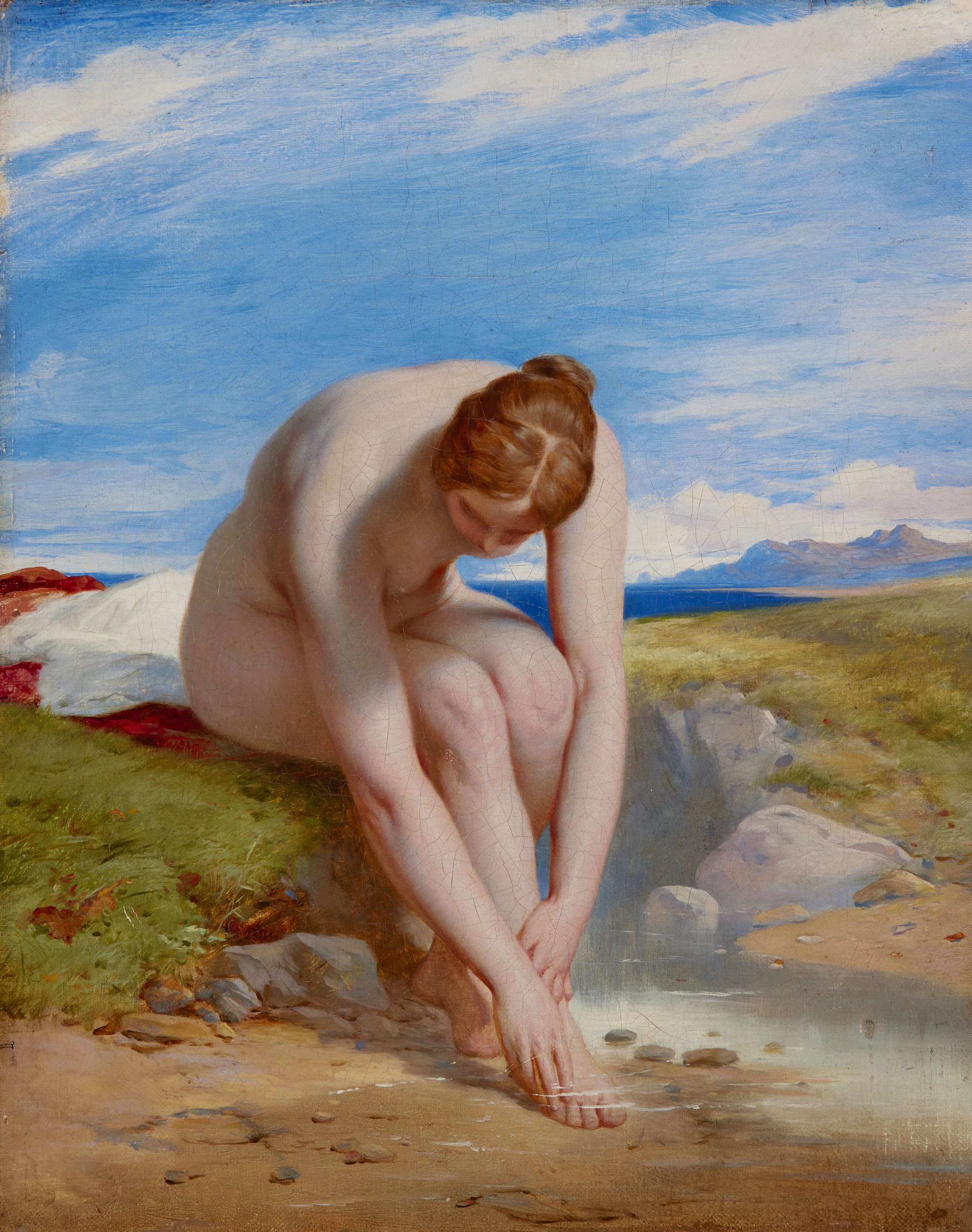
The Bather
Oil on Canvas, 35.5 x 28cm
Provenance: Sotheby’s London, 2nd October 1985 and formerly in the Evelyn Waugh collection
Born in Co. Clare in 1786, as a child Mulready had been brought to London, where as a young teenager he studied at the Royal Academy Schools. A lifelong friend of William Godwin, from an early age he worked as an illustrator for Godwin’s publishing house and in 1807 illustrated Charles and Mary Lamb’s Tales from Shakespeare. His contributions to William Roscoe’s The Butterfly’s Ball and The Grasshopper’s Feast, published that same year, were popular with the public, as were his illustrations for The Peacock “At Home” and The Lion’s Masquerade. From 1813 onwards Mulready concentrated on genre paintings, developing his own style of meticulous rendering, one that anticipates the Pre-Raphaelite painters. His earlier paintings were darker, and in the Dutch style, while in later years he painted with brighter colours, over a white ground. A regular exhibitor at the Royal Academy throughout his life, his last painting shown there, The Toy Seller, is now in the National Gallery of Ireland. Mulready died in Bayswater, London, in 1863.
From the outset of his studies at the Royal Academy, Mulready was celebrated for his drawings of nude figures, and right up to his last years he regularly attended life drawing classes. In his diary, Nov 11th 1857, Richard Redgrave commented "I believe Mulready is seventy-three, and yet there he is, hard at work at the 'Life' ', like any young student. He is not only attending as Visi-tor, and drawing at the Royal Academy, but he is also one of a party who meet three times a week at Ansdell's for studying from the life." As a Vis-itor, or tutor, at the RA Mulready was not obliged to draw alongside the students, but he did so, partly to encourage them. A selection of his nude drawings were exhibited at Gore House in 1853, but as they were considered inappropriate for younger visitors, they were shown in a room of their own. Ignoring advice not to view them, Queen Victoria insisted, and she and Prince Albert expressed delight with Mulready's work, the Queen asking to buy one. Mulready's nudes were unusual for their time in that they avoided Classical allusions. Distinctly modern in feeling, they were clearly based on direct observation of the male and female body, and were generally done for their own sake, rather than as preparatory studies for paintings.
However, when he was in his sixties, and already well-established, Mulready embarked on a series of paintings of nude bathers. These included Women Bathing, or The Bathers (Hugh Lane Gallery), which was shown at the Royal Academy in 1849; Bathers Surprised (National Gallery of Ireland, 1852-3); and the present work, which probably dates to around 1850. His bathers were favourably compared to Titian's painting in the Ellesmere Collection, Venus Anadyomene, and the present work certainly has a Titian-esque sky, against which a young naked woman, seated by a river bank, washes her feet in the clear water. The woman's pose is decorous, and her face barely visible. In general, whether in paintings or drawings, Mulready's nudes are char-acterised by this sense of modesty, his figures are often seen from the back, their heads turned away from the viewer. This aspect of his work accords with descriptions of the artist's own personal-ity, which was cautious and reflective. That said, Mulready's sketchbooks contain erotic drawings, including scenes of nymphs and satyrs, that he would never have considered suitable for public viewing. A significant work in Mulready's career, the present work is both a fine painting and an important addition to the artist's documented oeuvre.
Dr. Peter Murray