 Image 1 of 1
€ Enquire
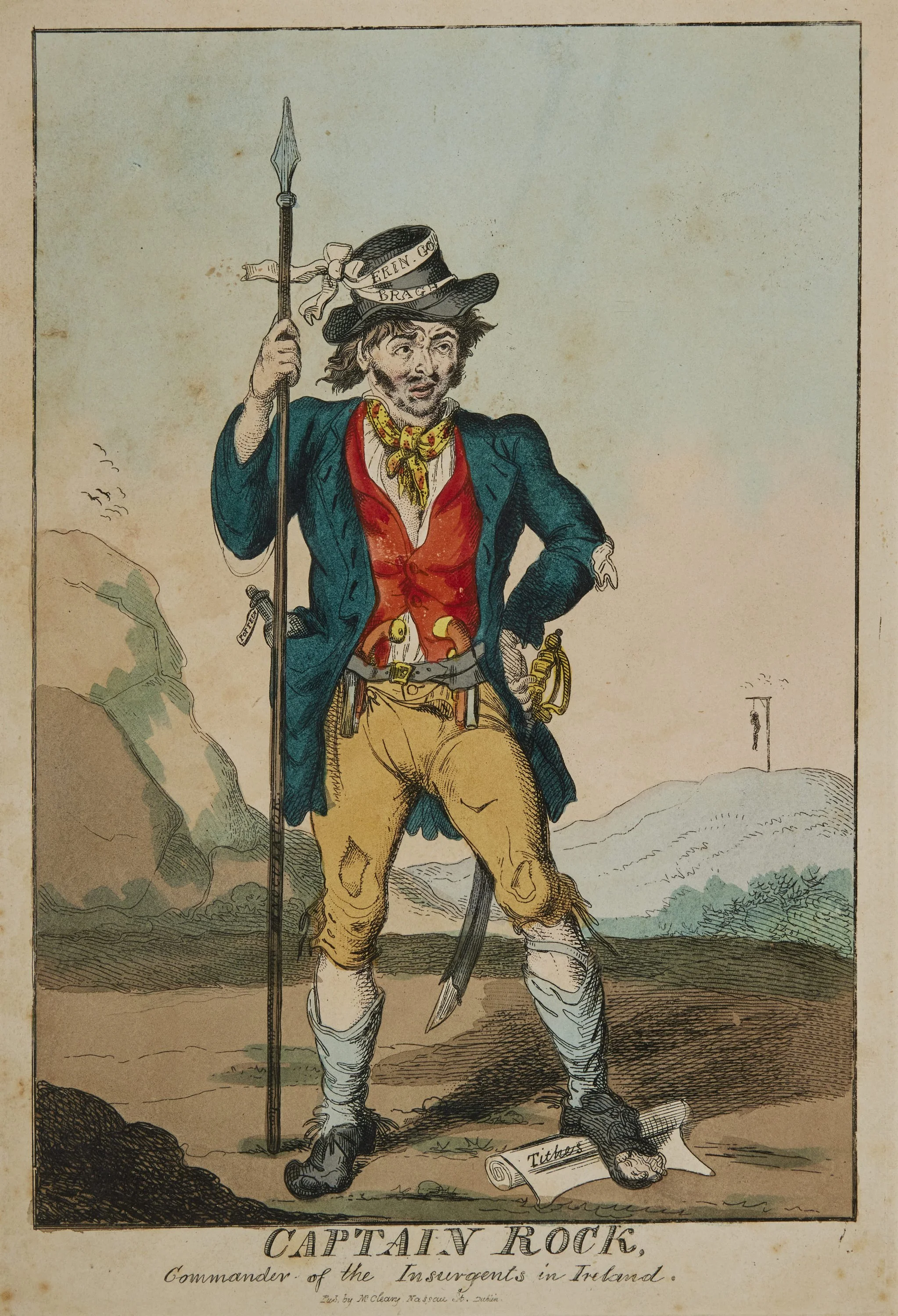
Captain Rock, Commander of the Insurgents in Ireland
Hand-coloured Etching, 33 x 23cm
The production of Dublin printsellers in the Regency period, notably William McCleary of Nassau Street, has recently been brought to critical and public attention through exhibitions at the Irish Architectural Archive in Dublin and the Driehaus Museum in Chicago (See Silvia Beltrametti and William Laffan (eds), Artists and Pirates, Graphic Satire in Georgian London and Dublin (2025)). This hitherto largely ignored body of graphic satire has been shown to be a vital, and original aspect of the visual, material and political worlds of early nineteenth-century Ireland. The small print-runs in which these caricatures were produced means that often only a handful of impressions of any print has survived. McCleary and others availed of the absence of copyright protection to plagiarise with impunity the work of the great London satirists such as Thomas Rowlandson and James Gillray. Less frequently, as here, they created original work of Irish subject matter. This extremely rare and quite possibly unique print – there is no copy in the comprehensive collection of the British Museum – is one of a small series of works from McCleary’s shop to explore the aftermath of the 1798 Rebellion. Taking its name (just as McCleary took his title) from the mythical, Irish folk hero, Captain Rock, Rockite agrarian activities had disturbed much of the south of Ireland, particularly Munster, in 1821-24 and this or perhaps just slightly later is the date of this print. A related image by McClearly shows ‘Mrs Rock, Lady of Captain Rock’ offering a confused reflection of the practice of Rockite adherents dressing in women’s clothing when perpetrating acts of violence against the property of iniquitous landlords, collectors of tithes for the Anglican Church (a tax greatly resented by the Catholic peasantry) and informers. In 1824, very close to the date of McCleary’s print, the poet Thomas More had made the rebel leader the hero of his Memoirs of Captain Rock: The Celebrated Irish Chieftain, with Some Account of His Ancestors, while dating from the following decade and offering a rather different take on the same iconography of popular resistance is Daniel Maclise’s Installation of Captain Rock (National Gallery of Ireland). Here, Captain Rock, ‘Commander of the Insurgents in Ireland’ is shown heavily armed with pike, pistols and sabre and with a bottle of poitín in his pocket. With his foot he firmly crushes a scroll marked ‘Tithes’. In the distance a figure hangs from a gallows. Like Gillray’s Portrait of an Irish Chief the image is ambiguous, combining caricature with respect.
€ Enquire
Captain Rock, Commander of the Insurgents in Ireland
Hand-coloured Etching, 33 x 23cm
The production of Dublin printsellers in the Regency period, notably William McCleary of Nassau Street, has recently been brought to critical and public attention through exhibitions at the Irish Architectural Archive in Dublin and the Driehaus Museum in Chicago (See Silvia Beltrametti and William Laffan (eds), Artists and Pirates, Graphic Satire in Georgian London and Dublin (2025)). This hitherto largely ignored body of graphic satire has been shown to be a vital, and original aspect of the visual, material and political worlds of early nineteenth-century Ireland. The small print-runs in which these caricatures were produced means that often only a handful of impressions of any print has survived. McCleary and others availed of the absence of copyright protection to plagiarise with impunity the work of the great London satirists such as Thomas Rowlandson and James Gillray. Less frequently, as here, they created original work of Irish subject matter. This extremely rare and quite possibly unique print – there is no copy in the comprehensive collection of the British Museum – is one of a small series of works from McCleary’s shop to explore the aftermath of the 1798 Rebellion. Taking its name (just as McCleary took his title) from the mythical, Irish folk hero, Captain Rock, Rockite agrarian activities had disturbed much of the south of Ireland, particularly Munster, in 1821-24 and this or perhaps just slightly later is the date of this print. A related image by McClearly shows ‘Mrs Rock, Lady of Captain Rock’ offering a confused reflection of the practice of Rockite adherents dressing in women’s clothing when perpetrating acts of violence against the property of iniquitous landlords, collectors of tithes for the Anglican Church (a tax greatly resented by the Catholic peasantry) and informers. In 1824, very close to the date of McCleary’s print, the poet Thomas More had made the rebel leader the hero of his Memoirs of Captain Rock: The Celebrated Irish Chieftain, with Some Account of His Ancestors, while dating from the following decade and offering a rather different take on the same iconography of popular resistance is Daniel Maclise’s Installation of Captain Rock (National Gallery of Ireland). Here, Captain Rock, ‘Commander of the Insurgents in Ireland’ is shown heavily armed with pike, pistols and sabre and with a bottle of poitín in his pocket. With his foot he firmly crushes a scroll marked ‘Tithes’. In the distance a figure hangs from a gallows. Like Gillray’s Portrait of an Irish Chief the image is ambiguous, combining caricature with respect.