 Image 1 of 1
€ Enquire
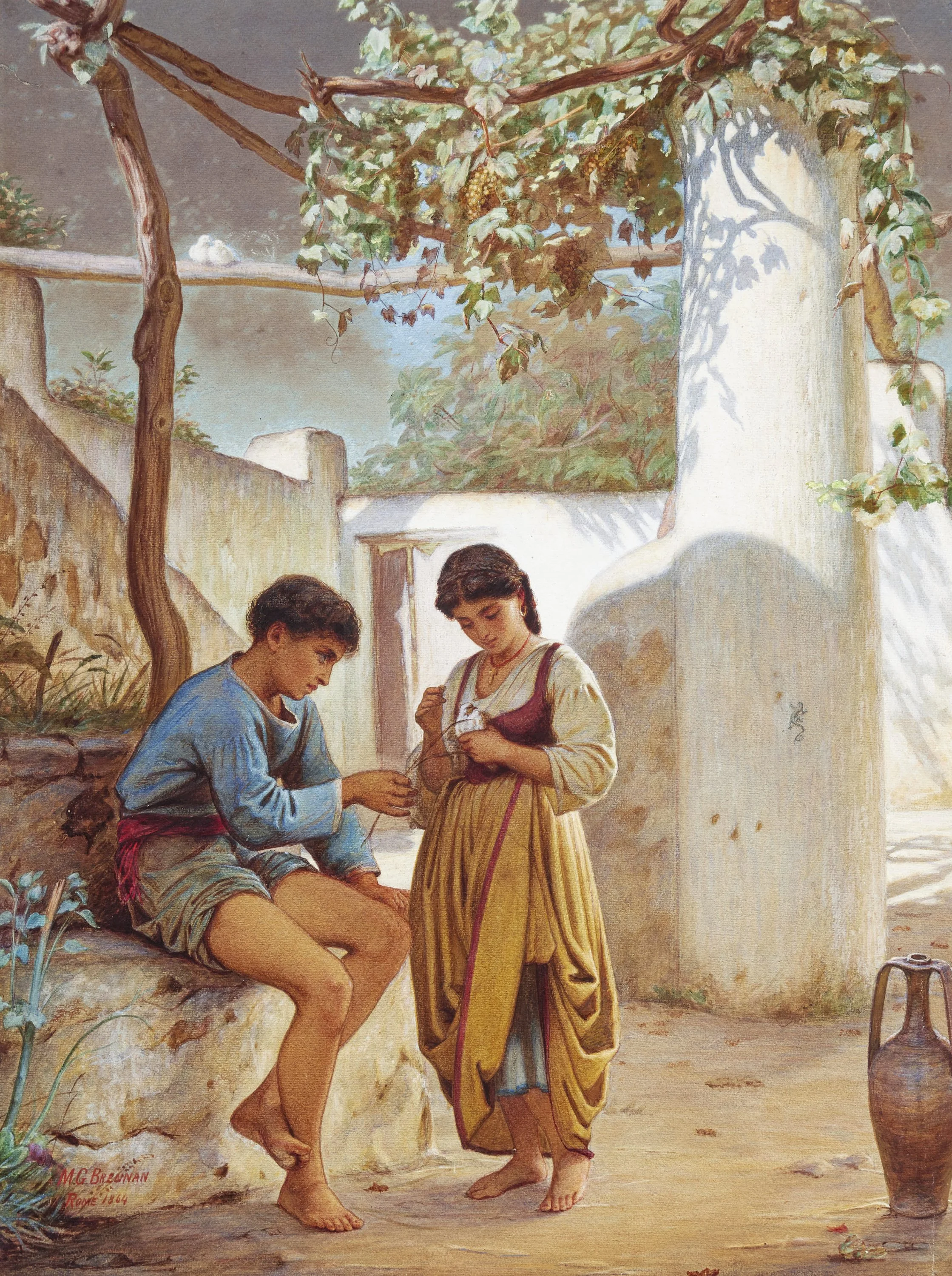
Vine Pergola at Capri
Watercolour and BodyColour on Paper, 58.5 x 43.5cm
Signed and dated ‘M.G. Brennan, Rome, 1864’
Although Brennan was acknowledged in his lifetime as a highly accomplished and precocious artist, ‘his early death away from Ireland means that relatively few of his works are known’ (Brendan Rooney, in A.A.I., vol. 2, 184), making this elegant Italian watercolour a welcome discovery. Brennan was born in Castlebar in 1839, and his early proficiency at drawing was recognised by local dignitaries, including the artist and traveller Lady Louisa Tenison, leading him to be sent to Dublin to study and then to London where he entered the Royal Academy Schools. Sadly at the R.A. he contracted typhoid fever which effected his health permanently, and like other artists similarly afflicted – from John Keats to Thomas Roberts – he sought relief in the warm- travelling to Rome in about 1863, the date before he painted this charming vignette which is inscribed as having been painted in the Eternal City but with its subject matter indicating that by this date he had already visited Capri in the Bay of Naples where he would settle. Here he portrays a courting young couple, shown barefoot in a vine-covered pergola. The bright light of the Mediterranean casts deep shadows on the whitewashed supporting pillar. Here Brennan anticipates his more ambitious oil A Vine Pergola at Capri of 1866, indeed he seems to use the same female model (National Gallery of Ireland).
By 1870 Brennan’s health forced him to leave Capri for Algiers where he was cared for by another aristocratic supporter, Lady Kingston of Kilronan Castle, County Roscommon who owned a number of his works. However, he died the following year. In addition to suffering with increasingly serious health issues, Brennan later years were marred by a broken engagement with the American poet Laura Catherine Redden (1839-1923). Brendan Rooney who has done so much to reconstruct Brennan’s life, gives a good assessment of his life and art. ‘[He] appears to have been a gentle modest and whimsical character whose work demonstrates a genuine interest in people and their everyday social activities. He was undoubtedly technically gifted, and there was an impressive breadth to his oeuvre’ (ibid.).