 Image 1 of 1
€ Enquire
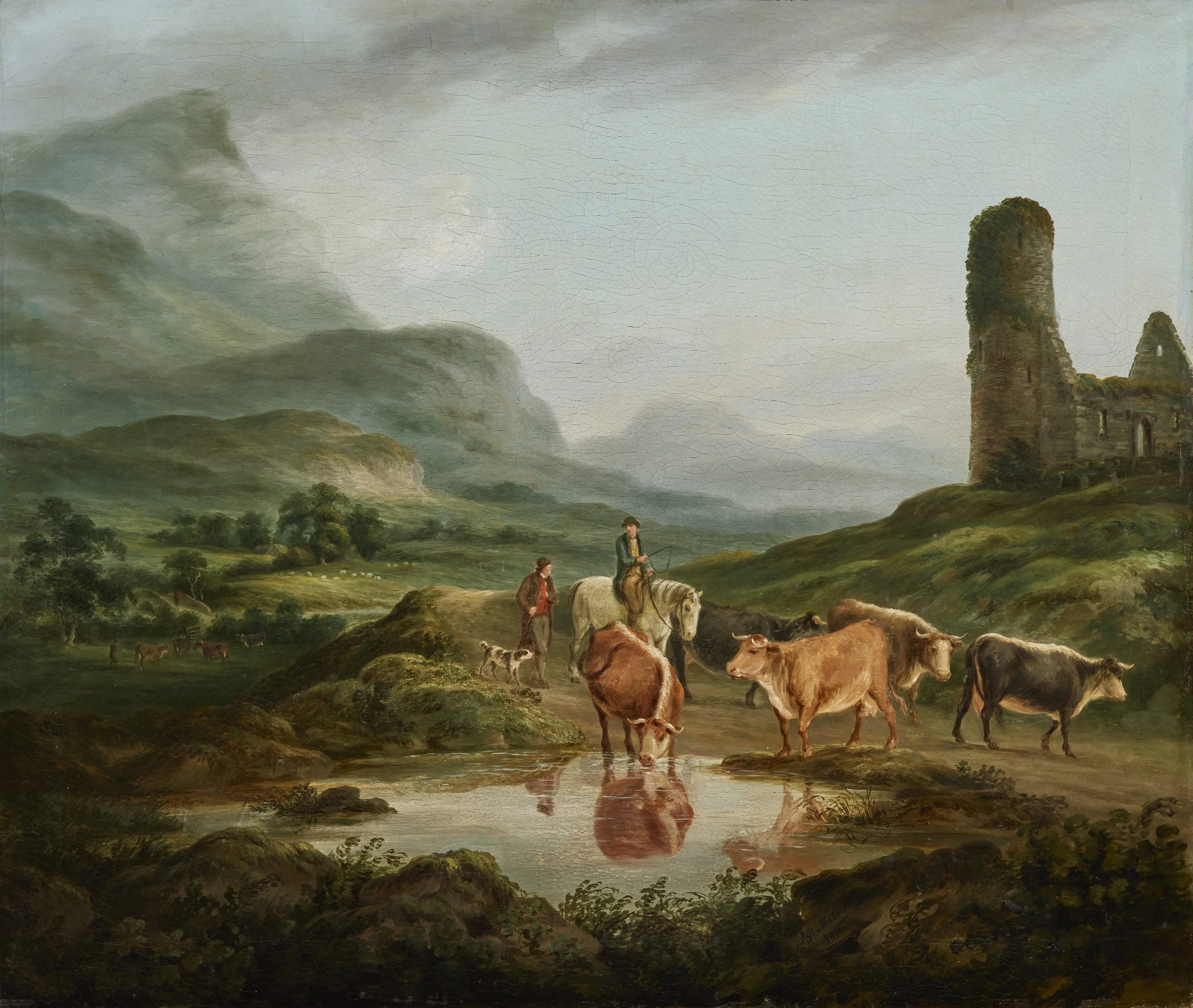
Mountainous Landscape with a Ruined Church and Cattle Drovers by a Stream
Oil on Canvas, 76.2 x 90cm
Signed and dated 1810
In original Regency-style frame
Exhibited possibly in the Society of Artists in Hawkins Street in 1810, which was the year of his first exhibit
Provenance: Private Collection, Dublin
Although this painting of a ruined abbey, with cattle drinking at a pond, is likely to be a ‘capriccio’ or imaginary view, elements of the composition may be based on Irish landscape, possibly the Lakes of Killarney. Mulvany has depicted the ruins of the abbey shrouded with ivy and silhouetted against a pale blue sky, with dark clouds above hinting at impending rain. Two drovers follow a small herd of cattle. One of the drovers is mounted on a horse, while the other is on foot, with a dog beside him. A cow drinks from the pond, its image reflected in the still waters. In the distance, at the foot of the mountain, a flock of sheep graze. The outline of the mountain is reminiscent of the Eagle’s Nest, between the Upper and Lower Lakes in Killarney. Signed and dated 1810, this work may have been shown that same year at the Society of Artists exhibition in Hawkins’ Street, at the home of the Dublin Society. Among works by George Petrie, William Sadler and James Arthur O’Connor, Mulvany’s painting Landscape, Composition was listed in the catalogue as No. 161. At the time of the exhibition, the artist was living at 4 Paradise-Row, off Dorset Street. Born around 1766,
Schools, where he won medals in 1782 and 1786. In 1813, while still living at Paradise-Row, he showed three paintings at the Society’s exhibition, including a view of Dunamase Rock in Queen’s County. Although he did not depict scenes showing hardship or adversity, Mulvany’s paintings are honest, eyewitness records of the places he visited. Unlike other artists of the Romantic period, he set out to show everyday activity in Ireland in the early nineteenth century. He delighted in recording muddy streets, with horses, cattle and dogs wandering freely. Wearing long coats and hats, the drovers in this painting converse as they follow the cattle. Although similar figures appear in other paintings by Mulvany, these are not picturesque ‘stock’ country folk, but instead are engaged in active conversation, transactions, and going about their business. The horses equally are not decorative appurtenances, but are working animals, carrying riders, or pulling carts. Over the years, Mulvany continued to exhibit regularly in Dublin, showing some forty two works at the RHA, whilst also teaching art. After 1813 he moved to North Richmond Street, Rutland Square, where he lived for the rest of his life. He died in 1838.
Dr. Peter Murray
€ Enquire
Mountainous Landscape with a Ruined Church and Cattle Drovers by a Stream
Oil on Canvas, 76.2 x 90cm
Signed and dated 1810
In original Regency-style frame
Exhibited possibly in the Society of Artists in Hawkins Street in 1810, which was the year of his first exhibit
Provenance: Private Collection, Dublin
Although this painting of a ruined abbey, with cattle drinking at a pond, is likely to be a ‘capriccio’ or imaginary view, elements of the composition may be based on Irish landscape, possibly the Lakes of Killarney. Mulvany has depicted the ruins of the abbey shrouded with ivy and silhouetted against a pale blue sky, with dark clouds above hinting at impending rain. Two drovers follow a small herd of cattle. One of the drovers is mounted on a horse, while the other is on foot, with a dog beside him. A cow drinks from the pond, its image reflected in the still waters. In the distance, at the foot of the mountain, a flock of sheep graze. The outline of the mountain is reminiscent of the Eagle’s Nest, between the Upper and Lower Lakes in Killarney. Signed and dated 1810, this work may have been shown that same year at the Society of Artists exhibition in Hawkins’ Street, at the home of the Dublin Society. Among works by George Petrie, William Sadler and James Arthur O’Connor, Mulvany’s painting Landscape, Composition was listed in the catalogue as No. 161. At the time of the exhibition, the artist was living at 4 Paradise-Row, off Dorset Street. Born around 1766,
Schools, where he won medals in 1782 and 1786. In 1813, while still living at Paradise-Row, he showed three paintings at the Society’s exhibition, including a view of Dunamase Rock in Queen’s County. Although he did not depict scenes showing hardship or adversity, Mulvany’s paintings are honest, eyewitness records of the places he visited. Unlike other artists of the Romantic period, he set out to show everyday activity in Ireland in the early nineteenth century. He delighted in recording muddy streets, with horses, cattle and dogs wandering freely. Wearing long coats and hats, the drovers in this painting converse as they follow the cattle. Although similar figures appear in other paintings by Mulvany, these are not picturesque ‘stock’ country folk, but instead are engaged in active conversation, transactions, and going about their business. The horses equally are not decorative appurtenances, but are working animals, carrying riders, or pulling carts. Over the years, Mulvany continued to exhibit regularly in Dublin, showing some forty two works at the RHA, whilst also teaching art. After 1813 he moved to North Richmond Street, Rutland Square, where he lived for the rest of his life. He died in 1838.
Dr. Peter Murray