 Image 1 of 1
11. James Arthur O'Connor c. 1792-1841
€ Enquire
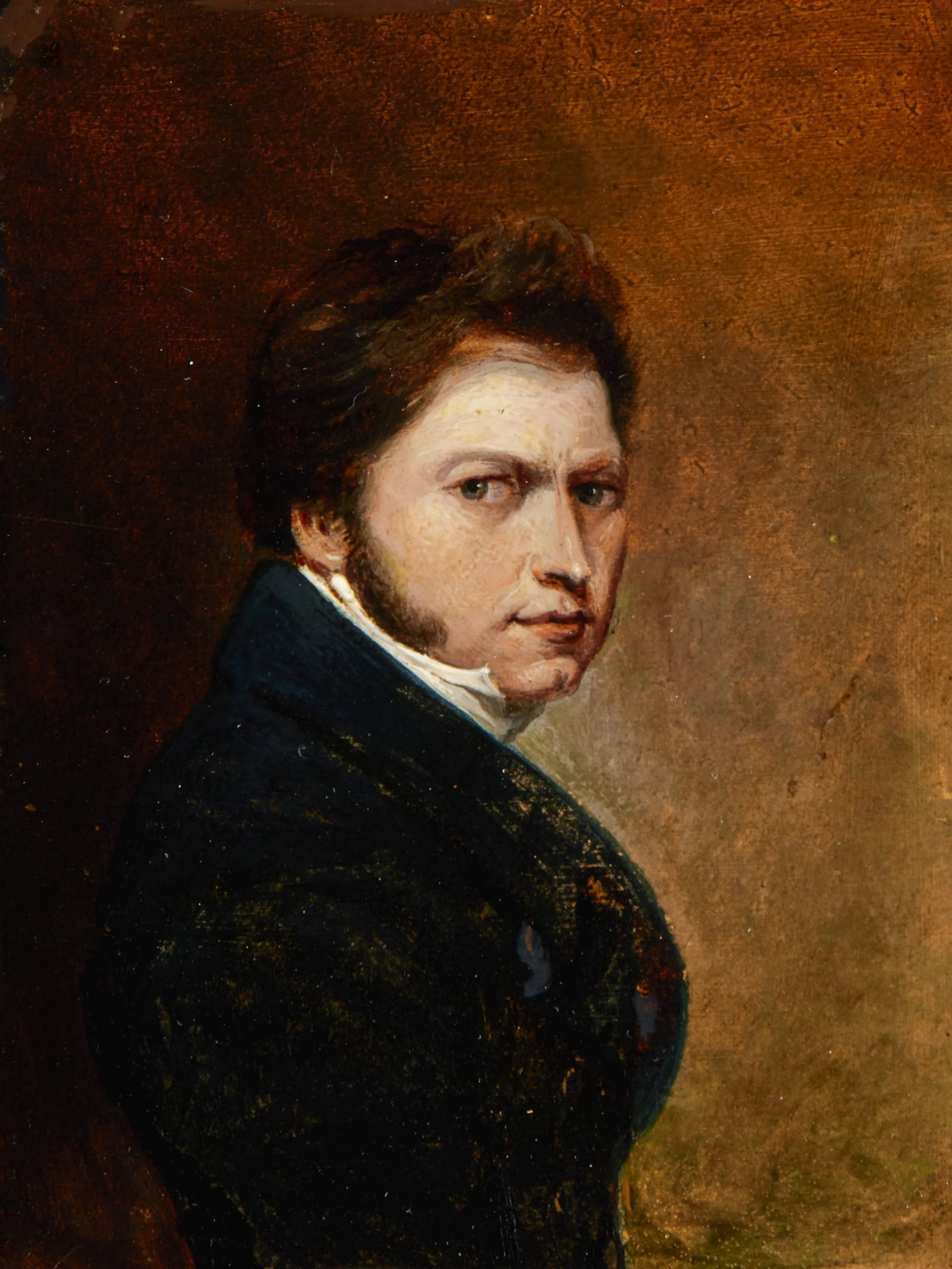
Self-portrait
Oil on Millboard, 11.5 x 8.8cm
Millboard manufactured by Davy (partial label verso)
This millboard was favoured by O’Connor at this time
‘Self-portraiture’, James Hall writes in his study of the subject, ‘has become the defining visual genre of our confessional age: the sheer volume of contemporary self-portraiture defies enumeration’. By contrast, self-portraits by eighteenth and early nineteenth-century Irish artists are rare, though James Barry and particularly Nathaniel Hone painted themselves in notable examples of the genre. This makes it all the more pleasing to publish here – for the first time in colour – this small self portrait of the perennially popular artist James Arthur O’Connor which, while known to scholars a century ago, was lost to sight for many years and was one of the most notable lacunae of the important exhibition dedicated to the artist at the National Gallery of Ireland and elsewhere in 1985-86. With the accompanying catalogue noting that the portrait ‘has not been traced’, a copy of the portrait was substituted for the original. The picture was, however, known to Walter Strickland who in 1913 reproduced it in his Dictionary, recording that it was then in the possession of Mrs Bury, 1 Ardilaun Terrace, North Circular Road, Dublin. It was still owned by Mrs Bury a few years later when it was again reproduced, with her permission, as the frontispiece to Thomas Bodkin’s essay on the artist in his Four Irish Landscape Painters. Bodkin notes that this seems to be the only portrait O’Connor ever painted and that it was completed before he left Ireland, therefore dating it to before 1822 when O’Connor settled in London aged thirty, having made an abortive trip to England in the company of Francis Danby and George Petrie some years earlier. Bodkin gives further provenance, tracing the painting right back to the family of the artist. At the date he wrote, 1920, the portrait was ‘in the possession of Mrs Bury of Ardilaun Terrace… whose husband is said to have bought it, many years ago, from the painter’s sister’.
Bodkin goes on to describe the painting: ‘it is on millboard and measures three-and a-half inches by four-and-a-half. He shows himself in a blue coat and bright white stock, aged about thirty, with fine eyes, a sensitive mouth, a straight nose and a broad forehead’. Perhaps the artist’s youthful features argue for a date some years earlier than circa 1822, as suggested by both Strickland and Bodkin. More subjectively, Bodkin continues ‘his look is troubled, as though he presaged his sad career’. This biographical reading of the painting in light of the worries that lay in the figure – and an early death that he can hardly have foreseen – does not wholly convince. Certainly, O’Connor does not look, as John Hutchinson suggests, ‘withdrawn and rather fearful’. Instead, he wears a di tinct smile while his somewhat fixed expression is the result of concentration – the act of looking into a mirror to record his likeness – not fear, or a manifestation of existential angst. A similar intensity of gaze – and indeed a similar smile – are features of John Constable’s self-portrait at a similar age (National Portrait Gallery, London). Instead, it is perhaps best to characterise O’Connor’s expression here as genial and somewhat earnest, closely reflecting his character as recorded in the pen portrait by George Mulvany who knew him well ‘a spirit of exceeding mildness; manly, ardent, unobtrusive and sincere’.
In addition to painting elegant demesnes, Norman castles and the most sublime aspects of the Irish landscape, O’Connor also enjoyed more workday subjects showing ordinary Dubliners at leisure. In Catalogue No. 13, for example, he paints a scene of bathers with two swimmers in a calm pool formed by the natural dam blocking the flow of a river. Their companion seems to be charged with caring for the pile of discarded clothes, which are painted with exuberant impasto to form a rich chromatic highlight. Unusually the foreground figure looks directly out of the picture to catch the viewer’s eye. Other bathing scenes by O’Connor survive. One shows the bathing hut at ‘Cranfield’s Baths’, which had been established sometime after 1797 between Irishtown and Ringsend. Here the flow of water contrasting with the reflective stillness of the bathing pool is captured with the most delicate of glazes and flicks of white paint contrasting with the squiggles of verdure. Dating from 1827 is a noticeably appealing landscape (No. 14) in which its small scale belies the grandeur of effect which O’Connor conjures from his familiar repertory of Irish scenery. The painting offers a rich chromatic contrast between sky blue and an array of verdure greens with his beloved trademark of a flick of red in the traveller’s waistcoat. In 1827 the year he painted it, O’Connor had just returned from a successful trip to Brussels and in these years of his ‘Middle Period’ he was painting some of his finest works. The picture was included in the major exhibition of Irish art held at Olympia in London in 1888 to which it was lent by Colnaghi’s. Showing a different aspect of his landscape art (No. 12) is an upright landscape dominated by a large tree on the left with two figures in patch of bright light on a path in the foreground.