 Image 1 of 1
€ Enquire
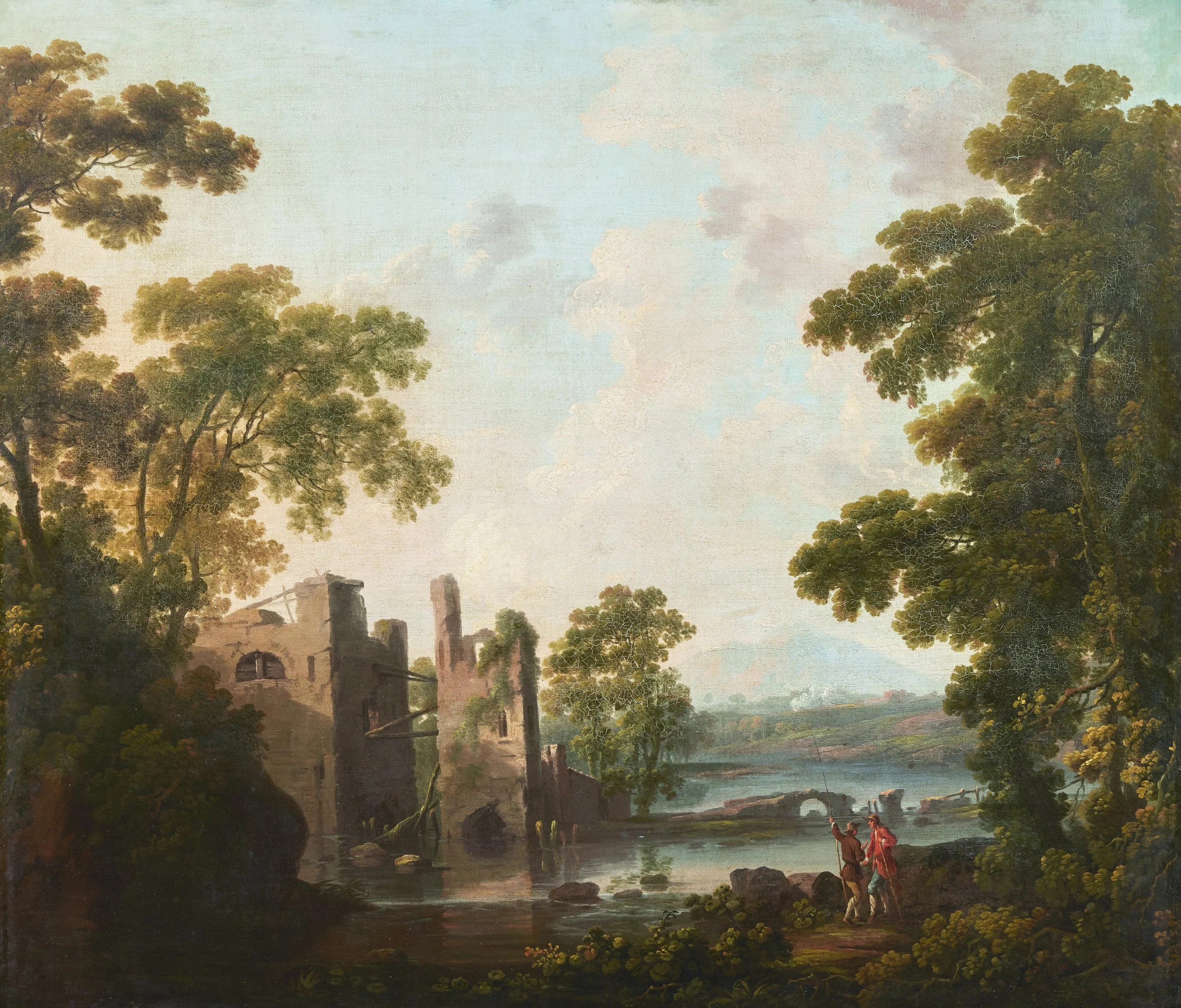
Classical Landscape with Figures
Oil on Canvas, 99 x 115.5cm
Enclosed in a carved giltwood frame
‘Ireland’ opined the German travel writer Johann Georg Kohl, ‘is the country of ruins. Here you have ruins of every period of history, from the time of the Phoenicians down to the present day’. In this major work by Barret, the complex of ruined buildings on the left of the composition is immediately recognisable as Irish and contrasts in this with the generically classical Italianate buildings that the artist includes elsewhere in his oeuvre to make for a fertile mix of the classical and indigenous that is the signature element of Barret’s art at his most engaging moment in Dublin of the early 1760s. In the years immediately preceding his departure for London, Barret seems to have been exceptionally busy and was receiving patronage from the most exalted levels of Irish society. This rather goes against Strickland’s assertion that Barret left Dublin for London as he was ‘finding little encouragement in his art.’ Certainly London offered wider scope for patronage but this is not to say that Barret was lacking commissions, or inspiration, at home and an analysis of his oeuvre indicates that he produced some of his finest paintings not in the cosmopolitan capital with all the opportunities that it offered but at home in Ireland. Dating from about 1760, this is an important and very attractive example of Barret’s art as a young painter in Dublin. A large and ambitious landscape, the composition is a noticeably accomplished example of Barret’s Irish period and shows several of the recurring structural characteristics for which he was so admired by his contemporaries. ‘Repoussoir’ trees to left and right frame the composition. This is succeeded by a passage of water in the middle ground and a distant view to mountains. All are enlivened by etiolated figures, which, over the course of his period in Ireland, evolve from rococo Italianate to more substantial travellers. Here, they are about half way in this progression as an elegantly dressed pair of fishermen meet to try their luck in the still river, half crossed by a broken bridge. Barret’s art of this period can be seen as a fruitful combination of the direct exposure to the breathtaking scenery of Ireland, and in particular County Wicklow, and his close study of the classical landscape tradition. The artist was to articulate the importance of these twin sources of inspiration in a letter to a young artist ‘paint from nature not forgetting art at the same time’. It is in lush, romantic – and resolutely Irish – works such as this that he made his most original contribution to landscape art and certainly this is the period of his art that has been most cherished by collectors.
We are grateful to Dr Logan Morse for her assistance in this catalogue entry.