 Image 1 of 1
27. Francis William Topham 1808-1877
€ Enquire
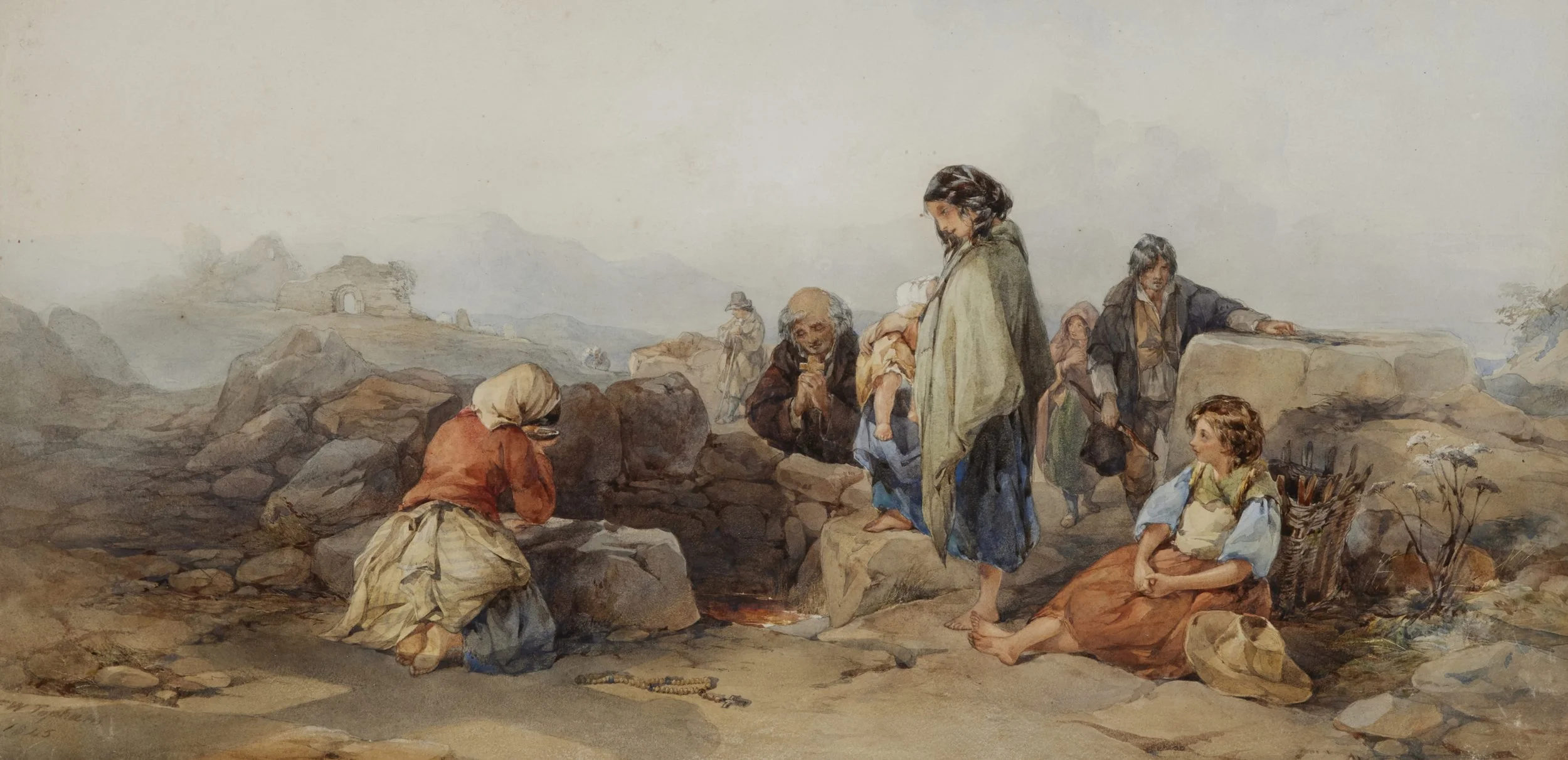
The Holy Well, Ballinasloe
Watercolour, Heightened with White, on Paper, 27.7 x 56.9cm
Signed and dated 1845
Pilgrims would circum-ambulate Holy Wells praying, drinking the water, and leaving votive offerings, in this case for a cure for sore eyes. This Saint Brigid Holy Well is set against the medieval church ruin and graveyard at Kilbegly, Ballinasloe, Co. Galway. Ballinasloe, moreover, was renowned for its annual agricultural fair, the largest in Europe, and was a place of huge folkloric interest. Topham visited Ireland in 1844, and returned in 1845, ’46 and ’47 to starkly deteriorating Famine conditions. His earlier ethnographic work appealed to major collectors in Britain, and now graces the Victoria & Albert Museum, the Guildhall, London, the Glasgow Art Gallery, the Walker Art Gallery, Liverpool, as well as Ireland’s Great Hunger Museum in America. Clients included the wealthy industrialist, Henry Vaughan, the connoisseur and cultural philanthropist who bequeathed the Turner watercolours to the National Gallery of Ireland. This painting was executed in situ as a prelude to the larger version in the Victoria and Albert Museum, Pilgrims to the Holy Well (Vaughan Bequest). Pil- grims to the Holy Well was critically well received, and engraved by W.J. Linton. The Illustrated London News (5 July 1845) declared it ‘one of the most masterly pictures in the Exhibition of the New Society of Painters in Water Colours.’ Another critic noted the wild Celtic type of beauty in the artist’s mind— soft grey eyes with black lashes, angular faces full of sweetness, and masses of hair growing low upon the brow. Raggedness has never been rendered so attractive as in Topham’s drawings, nor has any painter made us feel shoes and stockings such pure superfluities.1
Rare precursors include Holy Wells by Frederic William Burton and Frederick Goodall. Holy Wells show the connection between Irish people and their pre-Christian past. Although deemed by the colonial authorities as superstitious peasant practices, praying at Holy Wells was prescribed as the means by which the Roman Catholic clergy maintained their authority over the people. Depicting the Irish as superstitious was a staple disparagement but, when all else failed, religion was all there was for a desperate people. Most Irish artists – for humanitarian, political and cultural reasons – recoiled from such representation, which makes the visual records of these British artists all the more important. Spanning the topographical, the ethnographic, the folkloric, the historical, the political, the economic and the social, these are vital pictorial documents of the age. Topham’s paintings concede grace and poetry in the peasantry; the piety, he depicts, dispels any notion of brutishness and, in that sense, his painting is socially progressive, by the standards of the time.
Professor Emeritus Niamh O’Sullivan
1. A Handbook to the Water Colours, Drawings, and Engravings in the Art Treasures Exhibition: Being a Reprint of Critical Notices Originally Published in The Manchester Guardian, 1857.